Photo: Evan-Amos, Wikimedia Foundation.
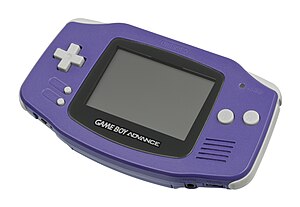
Long before anyone ever muttered the word "smartphone", Nintendo were making mobile gaming devices called Game Boy. The precise rationale behind their decision to gender their product line is a mystery, but the Game Boy line is the reason Nintendo were able to hold out so long against smartphone apps. The Game Boy Advance, released a month after the GameCube, was Nintendo's 32-bit system; they had stayed out of that particular fracas in the mid-'90s, but the time had finally come. The launch titles were composed of equal parts Super NES ports—like Super Mario Advance, which had originated as the Super Mario All-Stars version of Super Mario Bros. 2—and original games, like Iridion 3D and Army Men Advance.
Availability: Per-game (see below)
| 1 | ![]() |
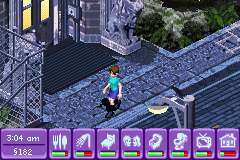
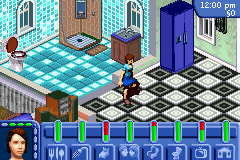
The Sims: Bustin' Out
December 2003, Griptonite Availability: none Sort of like The Sims-themed Harvest Moon, this game is more of a roleplaying game than a life simulator. There are goals to complete, people to talk to, chickens to catch, that sort of thing. Oh, yes, and a scooter to ride wherever you want to. Bustin' Out has the ability to link to the GameCube version, as well as to a second copy of the GBA version. Linking GBAs will unlock Daddy Bigbucks's stomping grounds of Paradise Island behind that sawhorse next to the Country Saloon, while linking to the GCN will allow you to transfer your Bust Out! mode sim to and from SimValley. |
|---|
| 2 | ![]() |
Super Mario Advance 2: Super Mario World
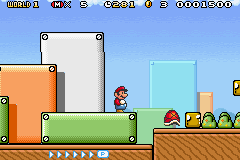
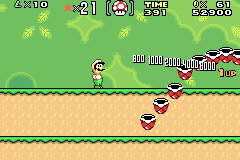
December 2001, Nintendo EAD Availability: Nintendo Classics Rather than be bothered with a next-gen Super Mario platforming game for GBA, Nintendo simply separated Super Mario All-Stars + Super Mario World into its base parts and released them at staggered intervals throughout the console's lifetime. Confusingly, Super Mario World happened between Super Mario Bros. 2 and Super Mario Bros. 3, thereby earning it the subtitle of Super Mario Advance 2 (as though calling SMB2, "Super Mario Advance", wasn't confusing enough). Nonetheless, it introduces Luigi as his own distinct character from Mario at long last. Luigi's fireballs have a higher bounce than Mario's, Luigi can jump higher than Mario in the same manner as SMB2, and Yoshi waits a bit before swallowing enemies with Luigi on his back, allowing him to spit them out and have them tumble across the screen until they hit something. If you prefer Luigi to Mario, you can alternate between brothers on the map screen with the R button. |
|---|
| 3 | ![]() |
Super Mario Advance 4: Super Mario Bros. 3
July 2003, Nintendo Availability: Nintendo Classics And, talking of Super Mario Advance, here is the last in the series. Incidentally, Super Mario Advance 3 was a port of Yoshi's Island. Nintendo clearly had great plans for the e-Reader cards that got scuttled by the falling prices of home document scanners, given the amount of e-Reader material that was cut from the North American release. Another interesting thing is how much of the unused content from the original Super Mario All-Stars release remained in this port; pointing to the fact that Nintendo were busy working on GameCube and DS stuff and just couldn't spare but a couple of interns to work on this port. |
|---|
| 4 | ![]() |
The Legend of Zelda: The Minish Cap
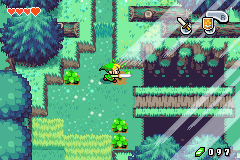
January 2005, Capcom Availability: Nintendo Classics, hShop Link sure has to do a lot of weird stuff to save the world, doesn't he? He has to burn bushes, go back in time, go forward in time, and even travel to the bottom of the ocean. This time, he has to shrink. Yes, that's right; the aforementioned Minish cap makes Link shrink. There's an entire miniature alternate universe that Link must inhabit in order to find items, get past obstacles, and, of course, save the princess. |
|---|
| 5 | ![]() |
Banjo-Kazooie: Grunty's Revenge
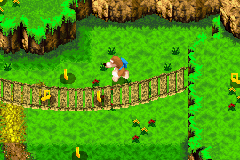
September 2003, Rare Availability: none Despite being a first-party developer for Microsoft by this time, Rare had been working on this game since 1999 and wasn't about to let corporate feudalism get in the way of finally doing something with it for a change. Obviously, since Microsoft could not be seen putting their logo on a Nintendo product and Nintendo could not be seen publishing a Microsoft subsidiary's game, THQ published it and saved everyone a headache. The gameplay is like a cross between Banjo-Tooie and Zelda, with all the collect-o-mania of the N64 games. Being a GBA game, it's comparatively short, but it doesn't suffer from this; games really should be completible in a weekend without having to suffer through 15 hours of manually-advancing dialogue cutscenes. Just the 1 hour will suffice. |
|---|
| 6 | ![]() |
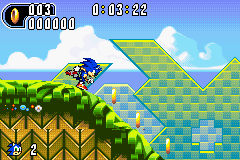
Sonic Advance
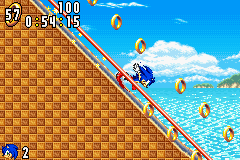
December 2001, Dimps Availability: none As we discussed before, Super Monkey Ball was the first Sega game to appear on a Nintendo console. Well, this game was the first appearance of Sonic the Hedgehog on a Nintendo console in broad daylight. It wasn't a workalike of Sonic the Hedgehog, like Bubsy, but a real live actual Sonic game. Several ideas that had appeared on the Dreamcast title, Sonic Adventure, were re-used here, such as rail-grinding. It was also the first game that was not a port of something to use Graphics Mode 7 and rotational sprite effects, as well as the first game to make use of the GCN Link Cable, in this case to connect with Sonic Adventure DX. Further, you have the choice of 4 characters, rather than just Sonic. There's Sonic, of course, but there's also Tails, Amy, and Knuckles. Choices are good, but I'm also a firm believer in female protagonists. You don't have to unlock Amy, she's just there from the beginning, making it superior to Sonic Advance 2 and 3 in that respect. |
|---|
| 7 | ![]() |
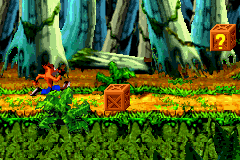
Crash Bandicoot: The Huge Adventure
March 2002, Vicarious Visions Availability: none Another breakout PlayStation title receives an installment on a Nintendo system, after a GBA port of Rayman in June 2001. The Huge Adventure is framed as a standard 2D sidescrolling platforming game. Occasionally, as in the PSX original, Crash has to run away from something by running towards the camera, giving the player a shortened window of reaction time to hazards on the track, such as boxes of Nitro. It's the first game not to involve Mark Mothersbaugh's music studio, Mutato Muzika, so that's a strike against it; but otherwise, it's the perfect next-gen platformer for this system. |
|---|
| 8 | ![]() |
The Urbz: Sims in the City
November 2004, Griptonite Availability: none While the console version of this game was nothing particularly special, the GBA version is a continuation of The Sims: Bustin' Out. While playing Bustin' Out is not a requirement for playing The Urbz, people who are familiar with it will notice that a lot of the characters have returned; such as the lifeguard-turned-gym-owner Misty Waters, the germophobic Dr. Maximilien Moore, and the villain of the piece, Daddy Bigbucks. Unlike Bustin' Out, which can almost be speed-run, The Urbz has a longer story mode, with some objectives requiring game-weeks to complete. At the same time, socialisation with other sims is easier, so building relationships and reputation don't feel quite so much like grinding. Whether you play this version or the Nintendo DS version depends on the emulation venue you're planning to use: PC, smart device, or jailbroken TV-based console; or jailbroken Nintendo 3DS. The available GBA emulators on 3DS don't like such huge ROM files as The Urbz, so a DS ROM is better. On all other platforms however, emulators don't care about filesize as much, so you can use the GBA ROM. There's absolutely no difference in gameplay between the 2 versions, except a very missable bonus area and minigame. |
|---|
| 9 | ![]() |
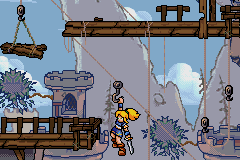
Lady Sia
September 2001, RFX Availability: none Here's a word we haven't used in a while: Metroidvania. Lady Sia is the story of the ruler of Myriade, trying to save her people from the savage T'Soa. While a masculine-presenting person does appear in the early stages of the game, they serve only a "tutorial mode" purpose and then aren't seen again until the end of the game; there's no occupation with love interests or any unnecessary stuff-and-nonsense usually associated with the protagonist being a woman. There's really only one other game series I can think of that does the same thing... |
|---|
| 10 | ![]() |
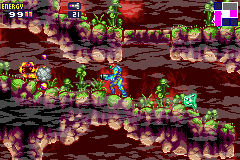
Metroid Fusion
November 2002, Nintendo R&D1 Availability: Nintendo Classics, hShop ...And that's Metroid. After all, we can't talk about "Metroidvania" without talking about Metroid, really, can we? Fusion isn't the longest game in the series, but being long is not a prerequisite for being good. Being released so soon after the Game Boy Advance, it's important to note that, unlike Super Mario Advance, Metroid Fusion is not simply a port of Super Metroid, though the storyline does reference events that occurred in that game. The game is a little heavy on dialogue, but blame Ocarina of Time for that. |
|---|
| 11 | ![]() |
Rayman 3
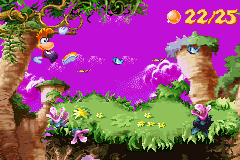
March 2003, Ludi Factory Availability: none The GBA version of Hoodlum Havoc has more in common with Rayman 2: The Great Escape than its GameCube counterpart, as art assets, music, and plot elements from Rayman 2 are used here as well. It's a 2D platformer, similar to the PlayStation original, with a hall of curtains instead of a map screen; but unlike the 2001 GBA port of that game, this one takes the smaller screen size more into account. Since Rayman physically takes up so much of the screen, his movespeed is a bit slower, enemies occur less frequently, and enemy attack speed is reduced. Don't let that fool you into thinking you can fall asleep and still beat the game, however; you'll be missing out on a lot of god-tier scenery art, and certainly you'll overlook the caged lums. |
|---|
| 12 | ![]() |
Batman: The Rise of Sin Tzu
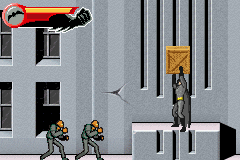
November 2003, Ubisoft Availability: none Batman is awesome; just ask any little kid. There's some violence in this one, despite its "E" rating, but nothing objectionable for a 3rd grader/4th year to play. The last game based upon Batman: The Animated Series, it managed to score higher on GBA than the home consoles, due to its traditional arcade-type gameplay. The bossfights are the only problem; they seem specifically tailored to drag on as long as possible and punish the player for missing opportunities for attack. That's a bit of bad game design to be sure, but the rest of the game is perfectly fine. |
|---|
| 13 | ![]() |
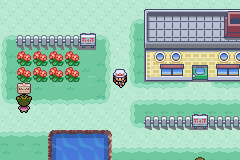
Pokémon Ruby / Sapphire
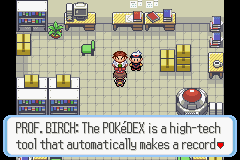
March 2003, Game Freak Availability: none It wouldn't be the Game Boy without Pokémon! The world's most celebrated roleplaying game takes players from Johto to Hoenn in the series' first GBA installment, which of course means loads more Pokémon to catch, more trainers to battle, and new locations to explore. |
|---|
| 14 | ![]() |
Castlevania: Circle of the Moon
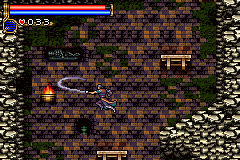
June 2001, Konami Availability: none Well, we may not have gotten a next-gen Contra game, but Castlevania made some impressive inroads on the GBA, beginning with Circle of the Moon. A GBA launch title, the game introduces a new magic system based upon collecting cards. It also boasts one of the most impressive non-Shin'en soundtracks in the history of the platform, complete with sampled choral chanting. |
|---|
| 15 | ![]() |
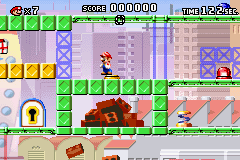
Mario vs. Donkey Kong
May 2004, Nintendo STC Availability: hShop The final Mario game released for the GBA, Mario vs. Donkey Kong is the spiritual successor to the 1994 Game Boy version of Donkey Kong. Rather than kidnapping anyone, Donkey Kong has broken into Mario's toy factory and stolen the last shipment of Mini Marios. While it does have basic platforming elements, Mario vs. Donkey Kong classifies more as a puzzle game, insofar as Mario needs to press the proper sequence of switches in order to open and close gates in the necessary order to achieve objectives, such as returning a key to the exit door or rescuing a Mini Mario. Clearly, Nintendo had no interest in the Game Boy Advance anymore, since a proper soundfont wasn't even created for this game, simply using the Microsoft GM Wavetable like a common installation of Windows XP. |
|---|
While these 15 games are sure to spice up your jailbroken New 2DS XL, there are 5 that didn't quite make the cut, but are still worthy of consideration.
| A | ![]() |
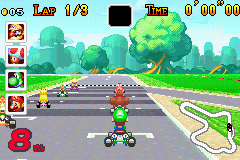
Mario Kart: Super Circuit
August 2001, Intelligent Systems Availability: Nintendo Classics, hShop Mario Kart comes to the small screen! Unlike its N64 predecessor, Super Circuit's game mechanics have more in common with Super Mario Kart; this can make the game somewhat difficult to control for people accustomed to Mario Kart 64's precision controls. But, with a bit of work, you can learn how to consistently drive on the pavement. It may take a few runs around Peach Circuit, but you can do it! |
|---|
| B | ![]() |
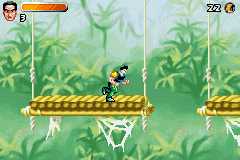
Action Man: Robot Atak
September 2004, Magic Pockets Availability: none This is one of those franchises that's sort of like Astérix and Lucky Luke, in that it's pretty much unknown to North American audiences. Based upon a direct-to-video film by the same title, Robot Atak is the archetypal "boy game"; musclebound men running about with weapons, destroying robots. Since we didn't get anything but a port of Contra III, Robot Atak fills the Contra-shaped void in the GBA's game library. |
|---|
| C | ![]() |
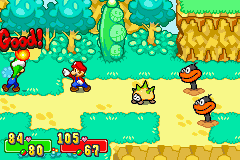
Mario & Luigi: Superstar Saga
November 2003, AlphaDream Availability: Nintendo Classics A new installment in the Super Mario RPG series, Luigi gets to join in for a change... whether he wants to or not! The evil witch, Cackletta, has stolen Princess Peach's voice and replaced it with explosives, complicating Bowser's latest attempt to kidnap her. He appeals to the Mario Brothers to get her voice back so he can carry on with the plan. Incidentally, this is also the final game to contain Nintendo's updated version of Mario Bros. that they had been including in every Super Mario Advance title since launch day. "Wait, aren't you also recommending this game's 3DS remake?" Yes, but I decided it's up to you to decide whether you like the original or the gentrified remake. |
|---|
| D | ![]() |
Sonic Advance 2
2002, Dimps Availability: none Somewhat more cinematic than the rather straightforward Sonic Advance, SA2 introduces the new characters, Cream and her Chao friend, Cheese. Unlike the first game, Sonic is the only available character on first-boot, with Cream, Tails, and Knuckles following throughout the rest of the game. Amy Rose only appears as an Easter egg "Luigi in Super Mario 3D World"-type character after a ridiculous amount of prerequisites have been met, so it's still pretty much 3 boys and a girl. |
|---|
| E | Pokémon FireRed / LeafGreen
2004, Game Freak Availability: none The first in what would prove to be a long line of next-gen remakes, FireRed / LeafGreen is, as it sounds, a next-gen remake of the Game Boy game, Pokémon Red / Blue (LeafGreen referring to the Japan-only Pocket Monsters Green). Rather than just a straight port, certain new features were added to the game; most notably the ability to play as a boy or a girl. The wireless adapter that came packed in with the game cartridges was extremely short-lived, being obsoleted very quickly by the Nintendo DS's total incompatibility with GBA multiplayer functionality; however, all of the official game events that required it have been quite over for about 20 years now, and its core function has been replaced by your jailbroken 3DS's near-field communication ability. |
|---|