15 Essential Games for Nintendo GameCube
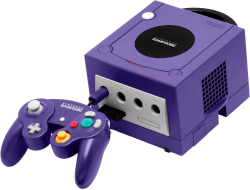
Photo: Evan-Amos, Wikimedia Foundation.
The successor to the Nintendo 64, the GameCube took full advantage of the freefalling cost of RAM and 3D graphics. While full 3D was still very much in the realm of computer science and engineering when the N64 was being developed, so many game design houses spending so many years bringing it to everyone's sitting rooms spurred on chipmakers to shoehorn more and faster transistors into their next-generation GPUs, allowing the GameCube to do more than two Nintendo 64s, condensed into a smaller space with fewer components. Third-party development was less of an issue this generation owing to Nintendo's choice to use a MiniDVD format instead of cartridges for game delivery. Also, more game engines supported the hardware, making it somewhat easier to make a game for GameCube, relative to N64. Since it cost less to experiment now, you didn't end up with any Superman 64-type game that treated the GameCube's hardware as an obstacle instead of a platform, and more developers were seeing what they could get away with in the open-world exploration department.
How to abbreviate this console's name? We have NES, SNES, and N64, so "GC" is right, right? It's a matter of where you are, I suppose. Both "GC" and "NGC" were used by Nintendo in Japan. In North America, however, the sheer preponderance of companies and products that initialised to "NGC" would have swallowed up the GameCube into obscurity, or so thought Minoru Arakawa. "GCN" was the official abbreviation for the GameCube here; and, of course, whatever Nintendo of America does, Nintendo Europe has to do also, so it's "GCN" in Europe and Oceania, too.
In the interests of the ballooning costs of file storage media, each game's file size is given after the 💾 diskette icon.
Availability: Per game (Nintendo Switch2 only)
| 1 |
 |
Animal Crossing 
September 2002, Nintendo EAD
Availability: none
💾 19.1 MB
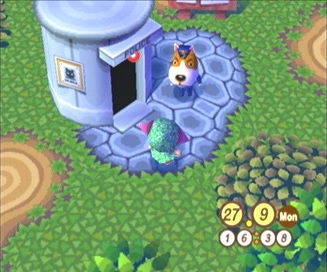
Originally scheduled for release on the Nintendo 64DD along with Ura Zelda and "several" other games (precisely which are not presently known), EAD managed to shoehorn Doubutsu no Mori into a standard N64 cartridge. As would occur at the end of the GameCube's lifespan with The Legend of Zelda: Twilight Princess ending up on Wii, this N64 game was ported to GameCube 8 months later. Overseas releases of the game were always intended for GameCube, as Nintendo of America had been hyping the new hardware intensely, causing attention to drift away from the Nintendo 64. Animal Crossing is non-linear, like its PC contemporary, The Sims, but it makes special use of the GameCube's calendar and clock, causing things to occur that are dependent upon the time of day and the month of the year. It does this through a persistent time model, synching the game time to realtime (or, as real as the often unreliable internal clock can get). Players who adjust their clocks for time-drift may get an uncalled-for visit from Mr. Resetti. |
| 2 |
 |
Luigi's Mansion
November 2001, Nintendo EAD
Availability: Nintendo Classics
💾 156.2 MB
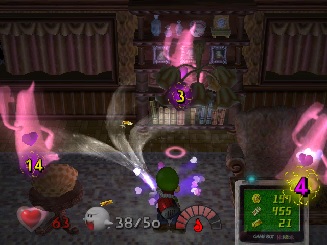
Having previously starred in his own game in the incongruous third-party title, Mario is Missing!, Luigi finally gets a quality game all to himself in this GameCube launch title. Luigi's won a mansion in a contest he didn't enter; Mario went ahead to inspect the place and never came back, so Luigi goes to find Mario and discovers his mansion is well past "haunted". It's infested with ghosts much in the same way that a place would be infested with bedbugs. The game is unusual for a Mario title, in that it doesn't have any platforming elements of any kind. Luigi must have left his jumping ability in his other shoes, because the only things he can do are walk, jog, the hoovering, and call for Mario. Still, it satisfied the need for a Mario-related launch title and set the GameCube apart from the Nintendo 64. Now, while Luigi got the shaft in Super Mario 64—not even appearing until the 2020 Gigaleak—Mario does appear in Luigi's Mansion, though he is not controllable and only appears in a picture frame. I guess Luigi is more considerate than Mario, letting his brother appear in his game at all. |
| 3 |
 |
Super Mario Sunshine
August 2002, Nintendo EAD
Availability: Nintendo Classics
💾 1.1 GB
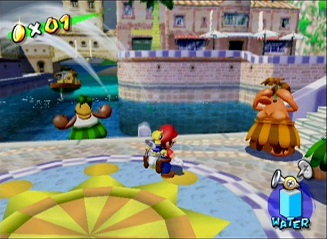
Of course, it just isn't Nintendo without a Super Mario platforming game. Luigi being preoccupied with his newly-exorcised mansion, Mario and the Princess (and a cadre of mushroom retainers) go on holiday to Isle Delfino. However, someone in a very obvious Mario disguise has been fouling up the island's ecosystem with a weird, water-soluble paint; so, naturally, Mario is arrested the moment he gets off the plane. No one ever accused the Piantas of being particularly intelligent. |
| 4 |
 |
The Sims: Bustin' Out 
December 2003, Edge of Reality
Availability: none
💾 1 GB
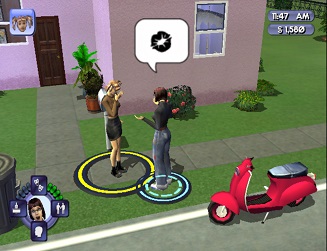
The follow-up to the first console release of The Sims, Bustin' Out has a much more robust story mode than its predecessor. The impression of a contiguous game world is given by use of Will Wright's iconic red scooter (or any of the replacement vehicles you're able to unlock as you progress), though you only ever travel in one direction. The game mechanic of unlocking things for Free Play mode in Story Mode is carried over from the previous game, but there's loads more to unlock here than the previous game. Also—while this won't help people playing on Dolphin or any platform except the GCN itself or the classic Wii—it's possible to link the Game Boy Advance version of the game to the GameCube version, unlocking a special arcade machine that allows you to play the GBA's minigames for cash in the GCN version, or to transfer a sim from the GCN into the GBA (you'll notice that the GBA refers to the GameCube by the abbreviation "GCN" as well). What's the point of that? Your GCN sim takes all of her cash and skillpoints with her to SimValley; then she makes money and builds skill in SimValley which she comes back to the GCN with when you're done. |
| 5 |
 |
The Sims 2 
October 2005, Maxis
Availability: none
💾 864 MB
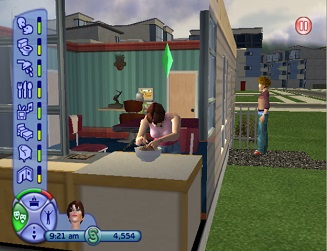
Originally intended as a sequel to The Urbz: Sims in the City, the Sims 2 angle was adopted most of the way through production when that game turned out to be a commercial failure and EA no longer wanted a sequel for it. The main difference between this game and all the Sims games that came before it was control—players were able to take direct control of their sim's movement as though they were Mario or James Bond. While the traditional "firepole" selector still exists, most of the game's unique socials and food creation system can only be taken advantage of while in direct control. Unlike Bustin' Out, there is no connectivity between the GCN and GBA versions of the game, which, quite frankly, is not a great loss considering how bad the GBA version is. |
| 6 |
 |
The Legend of Zelda: The Wind Waker
March 2003, Nintendo EAD
Availability: Nintendo Classics
💾 837 MB
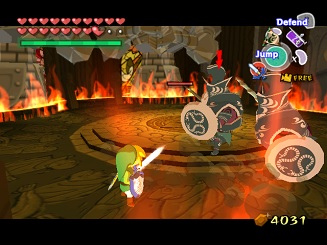
The GameCube's first official Zelda game used a radically different art style than had been seen previously on the Nintendo 64, and certainly was nothing like the Spaceworld 2001 tech demo which featured Link and Ganondorf fighting. Variously compared to Peanuts, South Park, and Rugrats, the cutesy cartoony cel-shading style remained with the franchise into the present day. Though the character design is decidedly less cartoony from Skyward Sword onward (unless you consider anime to be "cartoony"), Wind Waker introduced the unique, manga-esque art style to the Zelda series, thereby preventing it falling into the realism hole. |
| 7 |
 |
The Legend of Zelda: Twilight Princess
December 2006, Nintendo EAD
Availability: none
💾 896 MB
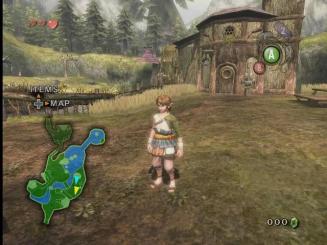
...But, let's pretend like Wind Waker never happened for a moment. As Animal Crossing had done at the beginning of the GameCube's lifetime—being ported to GameCube from the N64—Twilight Princess received a port for the new Wii. If you're familiar with the Wii version, something will strike you about this game straight away: everything was flipped on the Y-axis. The given reason for this was that Link is left-handed. All versions of Link have been left handed, even the 8- and 16-bit ones; when he faces the camera, his sword is in his left hand. Problem: Nintendo wanted to make Twilight Princess compatible with the new Wii Remote and Nunchaku attachment, and most players are right-handed. Rather than simply mirroring Link's model, they mirrored the entire game. That's why Kakariko Village is to the northwest on Wii and northeast on GCN. Apart from that, the GameCube version provides a more traditional control model than the Wii, being more like Ocarina of Time than whatever they were trying to do with motion controls. Whatever. |
| 8 |
 |
James Bond 007: NightFire
November 2002, Eurocom
Availability: none
💾 1.2 GB
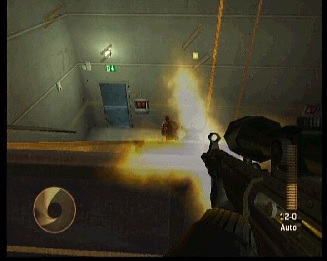
The second of four James Bond 007 games for GameCube, the enormity of the Windows version's maps has been dramatically scaled back, but the realism was jacked up to 11. It still looks a little artificial, but it showcases the GameCube's ability to draw shadows and lights far better than any of the other games in the series. Through relatively high-def texturing, the environments could be rather low-poly without anyone suspecting it, in contrast to the cartoonish colours and shading of Agent Under Fire and the strange 3rd-person perspectives of Everything or Nothing and From Russia with Love. Confusingly, even though Bond's countenance is that of Pierce Brosnan, his voice was recorded before Brosnan signed on; so it looks like Brosnan, but sounds like Maxwell Caulfield, because Electronic Arts. |
| 9 |
 |
Mario Kart: Double Dash!!
November 2003, Nintendo EAD
Availability: none
💾 384 MB
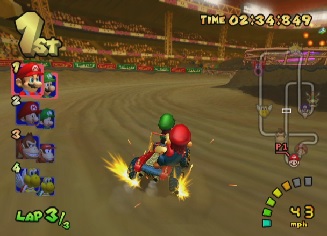
Unlike past (and future) titles in the franchise, you control a pair of racers this time, riding a single kart. For simplicity, one player controls two characters; in multiplayer mode, each player has their own pair of racers. For this reason, the character selection is based on doubles, opposites, and pairings. It sees the return of newcomer, Waluigi, to the Nintendo sports scene as a pairing for Wario, and the return to Mario Kart of the Koopa Troopas, who had been eschewed by Wario in Mario Kart 64. The relevance of this double character mechanic is evident in Grand Prix and Multiplayer modes, as each character has their own unique special item. |
| 10 |
 |
Super Smash Bros. Melee
December 2001, HAL Laboratory
Availability: none
💾 1.1 GB
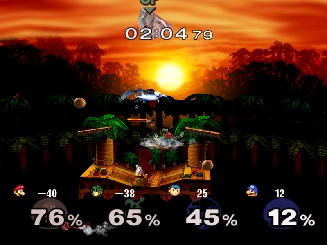
Super Smash Bros. had made such an impact on the Nintendo 64 that a sequel for GameCube was a given. Since the game wasn't expected to do as much as your standard platforming game, more attention could be paid to details, like rivets on the Mario Bros.' overalls, distant terrain in Story Mode, and signage in Onett. Unlike the previous game, every game series represented in the fighter roster had at least one stage of its own; including the long-forgotten Ice Climbers from the Nintendo R&D1 game for NES, Ice Climber. |
| 11 |
 |
Pikmin
December 2001, Nintendo EAD
Availability: none
💾 996 MB
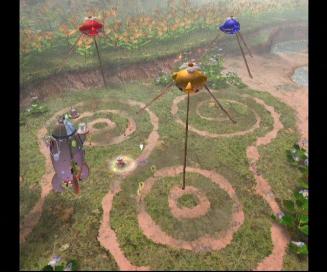
Pikmin is one of the more experimental games that Nintendo was up to during the GameCube era, the game starts off with your crash landing, when you wake up you find out that you only have 30 days till you die of oxygen poisoning... AND all your ship's parts are missing!!! Thankfully the little carrot like creatures named Pikmin are willing to help you get home, as you command them to fight and carry ship parts for you! Amazing game if you are looking for a real time strategy game that requires you to multitask with a tiny army!
Recommendation written by JaidenLE |
| 12 |
 |
Super Monkey Ball
November 2001, Amusement Vision, SEGA
Availability: none
💾 290 MB
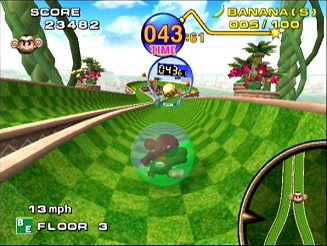
Another of the GameCube's launch titles, Super Monkey Ball is unique in that it is the first game published by Sega after the closure of their hardware development division, and the first game from a licensee of theirs to be released on a Nintendo system. Originating as an arcade game concept, called "Monkey Ball", it took approximately two months to port to the new hardware. At the same time, enhancements were added to the game, such as an interactive credits screen, 4-player simultaneous multiplayer, and a choice of four monkeys (AiAi, Mimi, Beibi, and GonGon, where the prototype featured only AiAi). |
| 13 |
 |
Rayman 3: Hoodlum Havoc
 Provisional; pending review Provisional; pending review
March 2003, Ubisoft
Availability: none
💾 1.1 GB
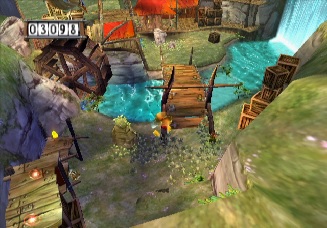
Somewhat more irreverent than its contemplative Nintendo 64 predecessor, Rayman 3 managed to fall into the celebrity hole, right along with 007 Everything or Nothing and Call of Duty: Finest Hour, insofar as Globox and Murfy just happen to be played by John Leguizamo and Billy West. Admittedly, not as star-studded a cast as Pierce Brosnan, Heidi Klum, John Cleese, and Judi Dench, with your music composer being Sean Callery of Bones fame, but it's the principle of the thing, really. I suppose, when you find you've got as much space on a GameCube disc as 4 N64 cartridges, you start to see what you can get away with in the art department, and in the new age, that means blowing mega money on a celebrity audio department. |
| 14 |
 |
SoulCalibur II
August 2003, Namco
Availability: Nintendo Classics
💾 760 MB
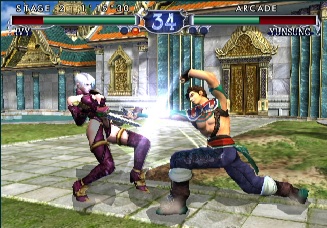
A fairly run-of-the-mill arcade fighting game, as had been seen before on Nintendo systems, as far back as Double Dragon for NES. The thing that sets this version of the game apart from the others, however, is the presence of Link. Remember that Spaceworld tech demo with Link squaring off against Ganondorf? Well the nearest thing to that is SoulCalibur II. Ganondorf doesn't appear, of course; but there are some fairly large opponents against whom you can fight as Link and just pretend. |
| 15 |
 |
Star Wars Rogue Squadron II: Rogue Leader
November 2001, Factor5
Availability: none
💾 1.3 GB
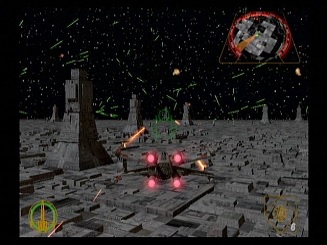
At last! You've been waiting since 1978 to fight the Death Star for real, and now you can do it! Participate in all the great battles of the original trilogy, as well as some unlockable funsies like playing as Darth Vader to attack the rebel fleet. I spoke of the celebrity hole earlier, but Rogue Leader subverts that hole in quite a humourous fashion. While Denis Lawson reprises his role as Wedge Antilles, the rest of the cast is a Who's Who of famous cartoon voice actors. Jeff Bennett, Tom Kenny, Grey DeLisle, and Kevin Michael Richardson for a start. These are people whose voices are immediately recognisable, but whose names and faces are unknown to 90% of the population. Also, the game's music was composed by Chris Huelsbeck, a name recognised pretty much only by people who play games. So, it's a Who's Who of "Who the Hell Is That?"; a celebrity hole that's only about a foot and a half deep. |
MAIN MENU | HOMEPAGE