|
|
|---|
 Enterprise NX-01 | 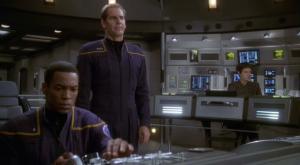 On the bridge | 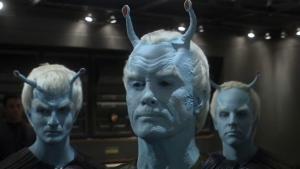 Andorians | 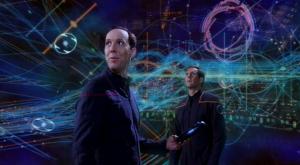 Temporal Cold War |
|---|
Fair Use of copyrighted materials:
The material is presented in lossy JPEG format at half of its original resolution or less. No more than 5 screenshots (1 title card, 4 episode stills) are displayed on the page. No more than 1 screenshot is taken from a single episode, including telefilms.
| Scott Bakula | as | Capt. Jonathan Archer |
|---|---|---|
| Jolene Blalock | as | Subcommander T'Pol |
| Connor Trinneer | as | Cmdr. Charles "Trip" Tucker III |
| Dominic Keating | as | Lt. Malcolm Reed |
| Anthony Montgomery | as | Ens. Travis Mayweather |
| Linda Park | as | Ens. Hoshi Sato |
| John Billingsley | as | Dr. Phlox |
| Vaughan Armstrong | as | Adm. Maxwell Forrest |
|---|---|---|
| Gary Graham | as | Ambassador Soval |
| Matt Winston | as | Agent Daniels |
| Jeffrey Combs | as | Cmdr. Shran |
| Randy Oglesby | as | Councilman Degra |
| Scott McDonald | as | Cmdr. Dolim |
| Rick Worthy | as | Councilman Jannar |
| Tucker Smallwood | as | Xindi-Primate Councilman |
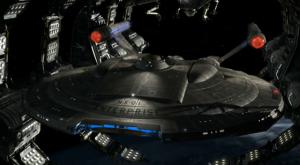
100 years before the Captain Kirk's 5-year mission, Starfleet's first interstellar ship sets out to begin charting deep space.
Set a course for Retcon, warp factor 4!
I could leave it at that, but my absolute dismay at Star Trek's prequel series truly cannot be understated. For a start, let's talk about prequels. In general, they didn't happen before Star Wars: Episode I. So, essentially, we have Star Trek capitalising on the success of Star Wars. When the first Trek film went into development, Gene Roddenberry was so sickened by the thought of Star Wars and the idea that his own series would be inevitably compared against it, he insisted that the Enterprise never engage in battle for the duration of the film. Other attempts at a prequel installment had been pitched, such as Harve Bennett's idea to set the 6th Trek film in the past, to show James T. Kirk as a cadet; all of which were dismissed out of hand. Now, however, Rick Berman was told "give us another hit", and so he went rooting around for ideas and arrived at the newfound market pre-occupation with prequels and said, "Yeah, do it." Mistake #1.
Mistake #2 happens naturally during prequels: retroactive continuity-smoothing, better-known as "retcon". The history of Starfleet and the Federation was not a new idea to fan-fiction writers and novellists, with stories about this subject dating all the way back to the late 1960s. By enshrining certain bits of this history in official canon, retcon is arrived at very quickly. Perhaps the most substantial bits of retcon I can think of offhand include these:
•The appearance of the Ferengi in 119-"Acquisition" contravenes the statement in TNG 105-"The Last Outpost" that Starfleet have never met the Ferengi before.
•Similarly, the appearance of the Borg in 223-"Regeneration" contravenes everything that is established about Humanity's history with the Collective in TNG and Voyager.
•406-"The Augments" retcons the Klingon foreheads. The fact of the matter is, the Klingons always looked like Kruge, Worf, and Martok; it's just that you had to use your imagination a bit, because the original show didn't have the money to do such a time-consuming makeup job. Remember "imagination"? Using your mind to conjure images? Apparently not.
But, enough retcon for now. Instead, let's talk about the discontinuity between the natural evolution of technology in the real world versus how computers looked in Star Trek. In 1966, Star Trek was pure science fiction. There was no magic time portal that allowed the set designers to see how computers would look in the future, so they used what they knew. That meant chunky, hulking, room-sized machines with lots of spinning wheels and blinking lights. There is no way to look at Enterprise's computers and think, "Yeah, they're gonna look like M5 and the engineering consoles pretty soon." Computers on the NX-01 have keyboards for fuck's sake! With display screens! Half the consoles on the Enterprise NCC-1701 don't even have displays. Why not? Because real computers in the 1960s didn't have them.
But, we'll just accept that technology is going to make some dramatic shift in design between NX-01 and NCC-1701. Let's talk about how Rick and Brannon completely undermined the entire utopian future of humanity that Gene created so they could do 9/11: Star Trek Edition. The only reason the Xindi arc happened at all was so they could re-introduce hatred and fear to Earth. Mike Sussman decided to go the extra mile and reintroduce bigotry while he was at it and had Phlox experience post-9/11 American racism on Earth to cap off the Xindi arc. "You gotta write what you know!" Well, maybe I'm getting enough of this from every other show on television right now, perhaps we don't need to hear it on Star Trek, too? You know, the show where the future is bright and hopeful?
Even in the most mediocre of mediocrity, there's still a highlight here and there.
S1E7-"The Andorian Incident". The return of Andorians to the screen for the first time since Star Trek 2.15-"Journey to Babel". Having the Andorians at war with the Vulcans was an interesting touch, since you always figured that Vulcans were more or less peaceful, thoughtful people because of Spock and Sarek. In general, the idea that the Vulcans held humans back in their development of warp technology always seemed contrived to create artificial conflict (a vain attempt to recreate the inherent discord between Starfleet and either the former Bajoran freedom fighters in DS9 or the Maquis in Voyager), but it makes more sense that Vulcan would have its own security concerns.
S2E2-"Carbon Creek". A different take on the overplayed Voyager "time travel" story, T'Pol tells Archer and Tucker a potentially-true story about a team of Vulcan scientists, led by her "second foremother", crashing on Earth in the '50s. Thus far, Enterprise had shown Vulcans to be cold and detached from humans, but this episode reminds viewers that the writer hasn't forgotten about Spock and Tuvok.
S3E9-"North Star. While searching down the Xindi superweapon in the Delphic expanse, Enterprise encounters a human colony that looks exactly like the American Old West. This is basically the only decent episode in this entire series, because it doesn't deal with the Space-Taliban at all. Have I mentioned how much of an unnecessary contrivance the Xindi arc was? Well, this episode only mentions them once.
Quite honestly, that's it. While I usually recommend watching S1E1 of any particular show, just to get an idea of what the show's going to be about, S1E1-"Broken Bow" promises a much better show than what would be seen. With the exception of these 3 episodes, Enterprise is otherwise an endless retcon and shark-jumping extravaganza.

 3/10 stars.
I appreciate the fact that the visual effects team worked their asses off to turn out decent shows, but the problem was in the fact of this programme's existence at all. A prequel was not what the doctor ordered, and it's not going to do anything but frustrate you if you're a fan of any of the other shows. More episodes than would be reasonable seem to be written like Baywatch shows: "Well, I know it's a stretch, but look at our sexy Vulcan science officer instead!"
I only made it about 6 episodes into the Xindi arc, and I'm already tired of it. So, I decided to change the star rating on 16 September 2025 from 4/10 to 3/10. Enterprise is definitely the weird stepchild in the Star Trek family. Sort of the Virtual Boy of the Star Trek set. The elephant in the room that you unsuccessfully tried to disguise as a grand piano. You get the idea.