|
|
|---|
 Mario Island |  Familiar enemy |  It's Bonus time! |
|---|---|---|
 Turtle Zone |  Cloud pointing up? |  Secret exit |
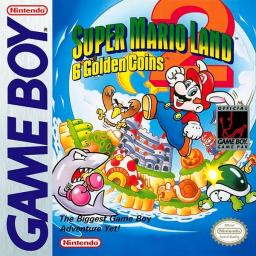
Mario's rival, Wario, jealous of his newfound wealth, paid off Tatanga to kidnap Princess Daisy. While Mario was out, Wario moved in and declared Mario Island to be Wario Island. To make sure Mario couldn't just come back and kick him out, Wario gave the keys to the castle door to 8 hired mercenaries. Mario is coming to discover that Island ownership isn't all it's cracked up to be.
I had a handful of games for the Flying Brick, and later the Game Boy Pocket, and Super Mario Land 2 is the only one I remember fondly. I'd already been introduced to Super Mario World by the time I got my hands on this one, but it was my first possession that could be described as a videogame. I can't tell you how many AA batteries I sacrificed to replaying the Macro Zone everyday after school. Oh, I never mentioned that, did I? Yes, in either a clerical mistake or a quirk of late-stage capitalism, Nintendo chose not to pack an A/C adapter in with the Game Boy, selling it separately for about $25. It wasn't until the Game Boy Advance SP and its rechargeable Nickel-ion battery that Nintendo deigned to provide some way of supplying it with consistent power. Anyway, I wouldn't say that this alone was my most prized possession at the time, but the acrylic carrying case with the Flying Brick Game Boy, 4 spare batteries, and this game cartridge was. Yeah, the Game Boy was on the way out, but I had trouble relating to my classmates in elementary school, and at least 10 other kids had Game Boys, so I became one of the gamer kids. Even the kids who had PlayStations had Game Boys. Not all of them, but there wasn't much variety in the way of mobile gaming until the smartphone revolution of 2009. It was usually either Nintendo or nothing. Even the Nintendo DS outperformed the Sony PSP here, even though the PS2 was outperforming the GameCube (and the classic Xbox was outperforming both of them combined).
10/10, would recommend. This game performs remarkably well, despite its age and lack of colour. Mario's relatively slow movements and the game's low gravity make up for the rather high number of enemies (so many in fact that they'll slow up the emulator at times), which also makes it an ideal starting place for gaming newcomers. It's short enough that you can complete it in 2 sittings, but the levels will reward players who take the time to explore. Following Hip Tanaka's similar decision with the game's predecessor, Kazumi Totaka's interesting decision to create completely new sound effects and music create a bit of a disconnect between this game and its home console counterparts, making it feel less like an official Super Mario game and more like its own sub-series— which, technically, it is. It makes it more like this game is unique— an outlier— amidst the often copypaste nature of the main series. Thus far, no mainline Super Mario game has made more than an obscure reference to it; the nearest we got to a full-throated reference was the bluegrass arrangement of the Athletic Theme in Mario Kart World...
THIRTY-THREE years later.