|
|
|---|
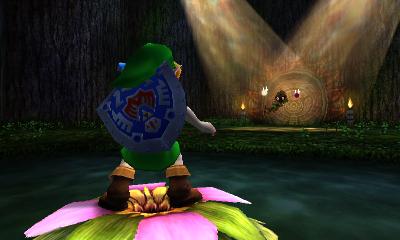 Skull Kid traps Link | 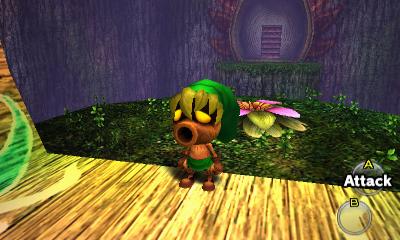 Deku Link | 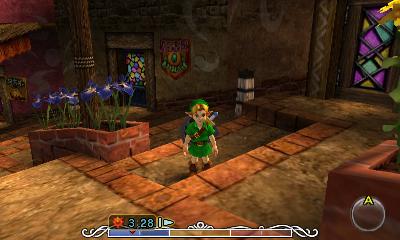 Clock Town |
|---|---|---|
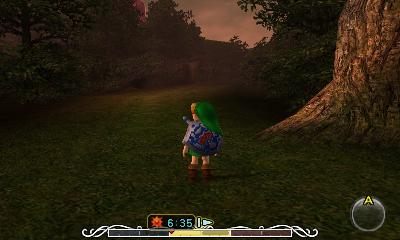 Termina Field | 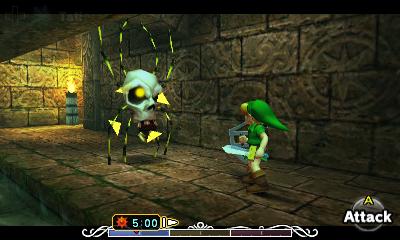 Big spider | 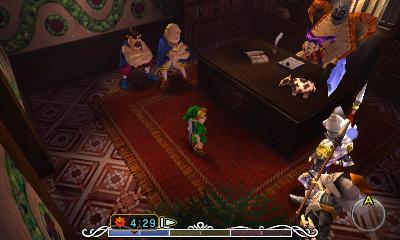 The mayor's office |
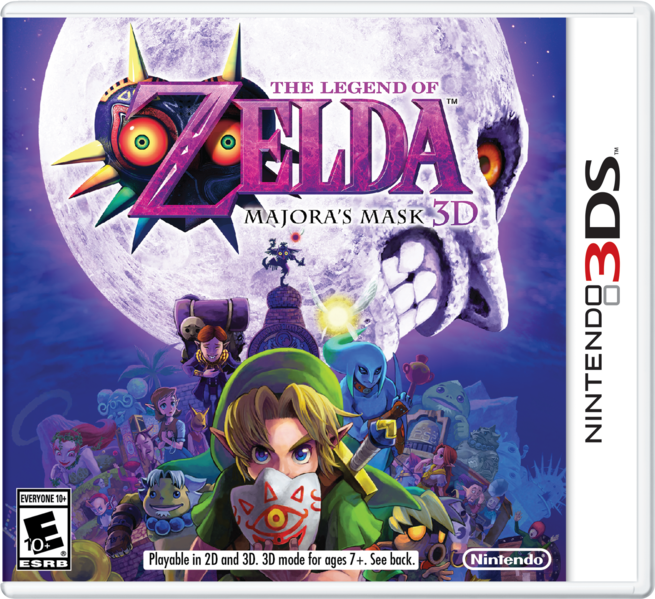
After being cursed by a masked Skull Kid into assuming the form of a Deku Scrub, Link and his new fairy partner, Tatl, chase Skull Kid to the strange parallel world of Termina, where everyone is the same, but different. Skull Kid has apparently gained quite the reputation as a troublemaker here, using his mask's dark magic to seal away the land's four guardian Giants. As if that wasn't enough, he also has pulled the moon out of its orbit and it will come crashing down directly onto Clock Town in 3 days. Link must use his Ocarina to manipulate the flow of time so he can complete his impromptu adventure before the moon destroys the planet.
First, the question everyone always asks about remakes: "how does it compare to the original?" The answer is... complicated. Superficially, the game received numerous quality-of-life updates from its N64 predecessor, such as the ability to activate Owl Statues as a Deku Scrub and an onscreen reticle while shooting Deku bubbles in first person mode. Also, there's the Spectacle. The graphics have been completely overhauled, as in Ocarina of Time 3D, and stereovision has been enabled for those of us playing on the 3DS. Just like GREZZO's other 3D remakes, only the graphics have been upgraded; the audio has remained largely constant. There's a tiny bit more reverb when the orchestra plays the Sun's Song at the beginning of the day, but otherwise there have been no substantive upgrades to the sound. For the layman, it plays identically to the N64 version (sure, as a pro audio producer and composer, I've noticed places where the sound has been changed or other sounds were substituted, but that just doesn't happen enough to be noteworthy). For the 21.2nd century gamer, Majora's Mask 3D is certainly more accessible than the original game, insofar as it doesn't leave quite so much to the imagination when it comes to graphics.
However, I grew up with the N64 version. To this day, I don't know why this is, but I absolutely loved this game on the Nintendo 64. I didn't really do anything but walk around Clock Town, but nonetheless I always looked forward to getting home from school and playing Majora's Mask. I think it was that I used to play in games. I didn't "play" the game for story progression, I played in the game as though I was playing on a playground. Just because no one else could see Luigi behind that pillar doesn't mean he wasn't there to me. Majora's Mask 64 wasn't the only game I did that with. Super Mario 64, GoldenEye 007, Mario Kart 64, even into Super Mario Sunshine and The Wind Waker. Well, suffice to say, time wore on, I got new games, The Sims was one of them, and I mostly forgot Majora's Mask 64. The next time I picked it up after October 2000 was when I got my bonus disc from Nintendo for pre-ordering Wind Waker 2 years later and I played it on my GameCube. I'd pawned the original cartridge at EB Games to afford another expansion pack for The Sims and so I was not able to play it anymore until I got it on GameCube. I never could figure out why they didn't include Link To The Past on that disc... at least not until LTTP+Four Swords was released for GBA. Anyway, we're not talking about that.
The fact is... maybe I'm just old now, maybe I was just young back then and was still capable of experiencing joy, maybe I'm just not as interested as I once was, but the 3D remake of Majora's Mask is not really anything special. Oh, it's novel, certainly. Everything about the 3DS was novel. Being able to play a game that looked like a window-box diorama was novel, feeling as though you could just reach through the screen and grab stuff. But, a girl can't live on novelty alone.
8/10, would recommend with reservations. I don't recommend this game for people who played the N64 original when it was new. However, for younger people, it's definitely one of the defining games of the Nintendo 3DS. Just be careful of where you jump in the Woodfall Temple; there's a skulltula trap that can lead to Deku Link into a softlock if you're not careful.
Before signing off here, one more fun fact about this game. Like I said, this game's soundtrack has not been altered substantially from the Nintendo 64 original; so that means this is true of the N64 version as well as this one: the voice of the Four Giants is Peter Vogel, engineer, samplist, and co-founder of Fairlight Instruments, Pty. Ltd. The operatic sample that Kondo used for the Giants' theme can be traced all the way back to the Fairlight CMI Series IIx, where it was originally released as "BAAA1"; a sample of Peter singing an operatic middle A at high volume. This, along with several other samples (notably "Arr1/SARARR") got nicked by E-MU Systems in 1986 for the Emulator II, and somewhere along the line, it got picked up by Roland for one of the L-CD1 sample CDs, where it ended up in Kondo's hands and he used it in this game.