Humans have been drawing for at least as long as we've been humans. Even today, give a little kid a piece of printer paper and a pencil and she'll draw something. Drawing is as central to being human as helping each other and sitting around a campfire, but it's a skill that a lot of us either neglect as we get older or we willingly give up for whatever reason.
I say "Pencil or Pen", but really, if it's able to reliably make a marking on a leaf of paper, you can use it to draw. It's only that pencils and pens tend to be the most common.
The problem that a lot of us encounter with drawing is "it's not going to be as good as this other person's drawing". That's a problem that everyone in any creative field at all has with their work: they compare their own work unfavourably against others'. If you're just starting out and you do this, you will usually end up convincing yourself into taking no action at all and simply leaving your paper blank. This is where image synthesisers like Midjourney are incredibly attractive: you are able to simply tell it what you're thinking of and it can assemble an image that sort of looks the way you were thinking. However, as we discussed in the introduction, this doesn't achieve any of your personal artistic goals and, while it may be novel the first couple times you use it, you become frustrated with the technology very quickly. The reason it frustrates you so much is exactly that it doesn't achieve any of your personal artistic goals and it never can. You can't develop a style with it, you can't learn anything from it, you can't fix any of its mistakes, and you can never get the same image twice. Relative to that last point, you can copy the image file and paste it into several different locations on your computer, but say you wanted the same picture of a cute girl standing on a cafeteria table but you want her hair to be pink instead of blonde. You can put the same exact words you used before into the prompt, but it will never return what you want. Everything will be drastically different.
The next thing we'll often run into is, how to draw. Maybe you want to draw pretty girls, maybe you want to draw cartoons, or architecture, or animals, but you don't know how. First of all, you can't draw anything without a personal style. This is as much about how you hold your pencil and how long or short your strokes are as it is about how you actually draw the picture. Before we even worry about technique (eg. how you hold the pencil and how long or short your strokes are), we need to practise just drawing. Draw something you don't care about, like the design on your coffee cup or the overflowing bin in your kitchen. You'll quickly find that what you thought would be simple to draw is actually pretty complex; the bin's sides actually slope slightly, the banana skin goes underneath the coffee filter, there's light glinting off the interior of that crisps packet. You won't be able to duplicate precisely what you see by the time you're done, but most importantly, you will have drawn something. You don't need to worry about showing it to anyone, you don't need to post it on social media, you don't need to hang it in a gallery, you just have to do it. You can never draw anything if you never draw anything.
Rather than an entire notebook, start out drawing on PostIt notes. They're only about 3 inches square, so there's less area to worry about filling in. You won't be able to get incredibly detailed on such small paper, meaning at some point you'll want to graduate to larger paper, like a spiral notebook or a legal pad. Don't even worry about rushing away and buying dedicated art paper yet, just use the office supplies you have on hand.
|
|
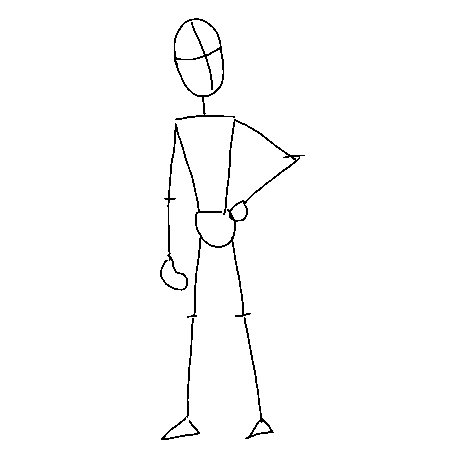
At some point, you will need your own posture reference dummy. This is basically a glorified stick figure that you can use to try out postures on a simple figure as opposed to just leaping into posing your human figures in a way you've never posed them before. Everyone, meet Stella, my posture reference dummy. Stella has helped me with loads of dynamic postures over the years, I first drew her when I was working for the after-school programme in 2019 where she helped me teach a 3rd-grader how to draw Batman. Now, obviously, Stella doesn't look a thing like Batman. But, she can be posed like him, which is half the thing; once you can see how a pose looks, you can pose your main figure that way.
It's important to note that a posture reference needs a neck. Even though sometimes it looks like people's heads just connect to their shoulders, everyone has a neck. Also, on Stella, here, her shoulders are as wide as her head; you can make your dummy's shoulders wider or narrower as your needs require, but for relatively realistic proportions (anything as realistic as or more realistic than your standard anime style), shoulders should be at least this wide. Also note the articulation points at the elbows and knees.
As you can see, Stella's hands and feet are indistinct. This is because you'll usually need a dedicated hand reference to work from when you get to that part of the drawing. Fortunately, hand references are easier to find, since all you need is a mirror and a camera, then you can take pictures of your own hand in the posture you want. Stella is here because we won't always be able to load an online posture reference database, and she's easy to draw and easy to pose.
Please note Stella's cross-shaped "face". This isn't put here at random, it's here to tell us what direction she's looking. On your larger figures, you can also use bent cross pilot lines to decide where their eyes are supposed to be and how to express perspective. On Stella, though, it's just to indicate where the figure will be looking.
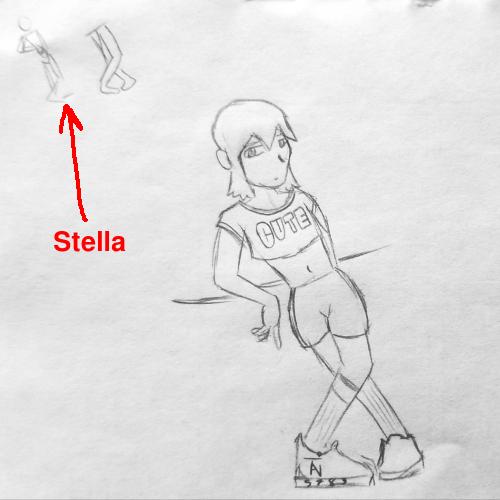
One last important thing about Stella, here. Drawing Stella doesn't count as making the whole drawing. I draw her really small in the top left corner of the page and then refer to her while I'm drawing the main figure.
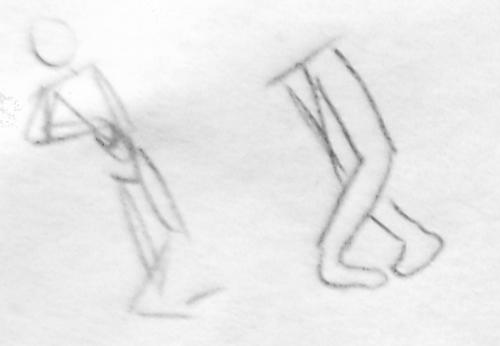
Before I ever drew Jinn here, I drew Stella leaning back against something. I also drew a closeup of Stella's legs so I could figure out how best to draw Jinn's legs when crossed. See how small and insignificant Stella looks up there? That's because she's just the posture reference. Her only importance was to me so that I could draw Jinn, leaning against a counter in a cute outfit.
Why are we spending so much time on drawing humans? Because that's what most people want to draw more than anything else. I haven't gotten into the particulars of how to draw faces, because I could do a whole webpage on that. I should. But not here. The only thing I'll say about it right now is this: If you're having trouble drawing the other eye? Your eyes are too complicated. Find a different way.
The most important thing to say about drawing is, don't be afraid to make mistakes. You'll make them. Everybody makes them. Even professional mangaka make them. Art teachers try to get you to ignore the eraser, but that's bad advice. The eraser is there for a reason, to help you fix mistakes. What you do is you get yourself a packet of Dixon Ticonderoga pencils, with the green-banded ferrule, because these are the best pencils in the history of time. As long as you don't mark so hard that you leave an indentation in the paper, you can erase your lines without them interfering with new marks. Anyone who tells you to never erase anything is probably trying to sell you something.
Let's go visit cherrypikkins on Tumblr and see how they draw figures. This tutorial displays the foundational underpinnings of art school drawing references, complete with step-by-step illustrations, demonstrating how the concepts work.
Just like in the writing section, don't feel like you need to turn any of these in to me. Just do them for yourself.
| A. | Using a pencil and PostIt notes, draw 3 still-lives from inside your home. |
| B. | In a notebook, draw 10 human figures without using a posture reference. Just work from memory here. |
| C. | Create your own posture reference dummy. |
| D. | Advanced. Using your posture reference, draw a larger figure using a pose from AdorkaStock. |