Released 31 October 2023
Recorded May 2010-January 2020 (non-consecutive)
Orchestral, new age
15 Tracks (44m 15s)

Track listing
| 1. Stay-cation | |
|---|---|
| 2. It's a Summer Thing | |
| 3. The Paved Frontier | MIDI sequence file |
| 4. City Sunset | MIDI sequence file |
| 5. Terrania | |
| 6. Sunday Driver | |
| 7. Generations | |
| 8. Pleasant Valley | |
| 9. Getting the Job Done | |
| 10. Illuminating | |
| 11. Assembly Line | |
| 12. Summer Fashions | |
| 13. Rain on the Road | |
| 14. Vacant Lot | |
| 15. Seasonal Chalet |
Originally released to Bandcamp for The Sims 20th anniversary in 2020, Myshuno's name comes from the most common way to interpret Bob Newbie's Simlish greeting to players upon loading the tutorial house. The album seems to have had a very long recording period—10 years—but I wasn't really thinking "album" at the time. The Sims has always been a unifying focus for my musical ability; from the very first time I started improvising on the piano in 2002 all the way up to installing new orchestral VSTi's in the present day, my first thought is usually "how can I make this sound like The Sims?" I'm not exaggerating when I say that I've been writing Sims music from my very first day as a musician.
As a result, there is, contradictorily, not very much MIDI data here. The reason for this is that, I used to write music longhand in NoteWorthy Composer. Basically, I just did it to impress girls when they would come up and see me writing something and, as they got closer, they could see that it was a musical staff and I was writing notes instead of words. Well, the number of girls I managed to impress this way was zero, and all I really ended up doing was giving myself a headache later. What I would write on paper, I would always say, "okay, this is the one that gets programmed into MIDI", and it never happened. Do you know how many partially written-in staff books I have lying around my room at home? At least a dozen, probably more. The fact is, I never wrote any Sims music this way, and I really only wrote 2 relevant songs in MIDI. They're both here: "The Paved Frontier" and "City Sunset". And, really, those have more to do with SimCity 3000 than The Sims. Most of my early Sims music was limited to Build Mode-like piano improv that I would record directly into the computer from the patch cable. The first time I actually used my workstation's step sequencer to write Sims music wasn't until 2013 or 2014; those are on the album. Technically, they are in MIDI format, but it's Roland's proprietary SVQ encoding. I could, of course, connect up my workstation to FL Studio and make proper MIDIs out of them, but not today.
In the First Age (2008-2015), I wrote music as notation in NWC, or I played it live and recorded it analogue style. In the Second Age (2015-2020), I used my Fantom X6's step sequencer to write the actual data for me while I played the piano keyboard as though I was doing 16 individual improvs. As one might imagine, that was way easier, and it let me actually start writing albums of music. There were still some principles I wasn't too clear on, like the note position quantiser, that it took me a couple years to figure out, but most of my Sims music came from this age. We are currently in the Third Age (2020-present), where my Fantom X has largely been replaced by FL Studio. It's still the same principle as the Second Age, but now I have a wider array of higher-quality instruments to compose with. Real Life Fast Travel is more emblematic of the Third Age.
"Rain on the Road" and "Vacant Lot" are the only holdovers from the analogue recordings of the First Age. I still have most of those old recordings, but these two were the only ones I thought didn't display newbie mistakes, like rushed tempo, compressor spikes, and missed notes. I guess the old saying, "the unapologetic self is the purest form of self", might apply here, but not on an album I want to sell for money. Anyway, if you're looking at a reconditioned Roland Fantom X8/7/6/a/R, these two songs are pretty fair demonstrations of how good the stock piano sounds. I'd put the Fantom X series up against any of the modern simulated Steinways and Bosendorfers that you have to pay $500 for these days. For that amount of money, get the Fantom Xa; you'll never look back.
"Stay-cation" actually started as the theme song for an OC of mine, Kendall Harker...
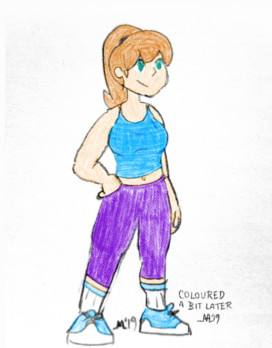
I had always envisioned her riding her bike cross-country to that song. I happened to have The Sims 3 loaded and onscreen at the same time I was writing this on my workstation, so I accidentally took really quite a lot of inspiration from it. When the Second Age ticked over the Third Age, I discovered that modern VSTi plugins are, for whatever reason, really, really bad at the marcato technique. In string instruments, marcato means, basically, the default technique for playing; you can hear the note attack, the sustain, and it carries on until you stop the bow. Fortunately, I was able to make my own marcato strings using factory patches Fantom X6 shortly after I got it in 2007, so I could use it there. It also features my custom pizzicato contrabass section (Roland seemed to forget that orchestral basses can play that technique just as well as jazz basses). It was also here that I discovered the oboe. Basically the only non-keyboard solo instrument in the whole Fantom X library that sounds any good is the oboe, so I used it and was quite surprised with how it turned out. This would translate into a somewhat unhealthy obsession with the Proteus/2 oboe in the Third Age. We didn't even have an oboist in our high school orchestra! How I got hooked on it, I will never know. Probably it has something to do with the fact that all the solo violins I'd ever heard a sample library make at that time were complete shite.
"Assembly Line" happened at around the same time as "Stay-cation". I'd wished that I'd made that song longer, but it's a pain in the ass to do that on the Fantom X6. Time sort of distorts while you're playing the piano into the sequencer. You think you've been playing for about 5 minutes, but you're really only about 45 seconds into it. Especially if you happen to be me; whenever I go somewhere and play the piano, I'm always convinced that people in the room are thinking, "Oh, not this again. Can't she just shut up already?" So, I end up compressing a 5 minute solo into 90 seconds, which is basically what happened with "Assembly Line".