I shouldn't have started that hidden status page, since I tend to update it more frequently than any other part of the website. "Why is it hidden?" Let's just say I don't want potential LCI licensees to find it. I do use part of this website professionally, after all (perhaps it would be better served by a different website? I'm not going to pursue that right now though).
I was on TCRF the other day and happened across their section on The Sims again. This time, they had some new information from the last time I was there; they had MIDI implementations of what we now know as NHOOD1.MP3 and BUY1.MP3; no acoustics of any kind, presented as sequenced audio played by an expanded Roland JV-1080—which, as you'll remember, was also Grant Kirkhope's sequencer of choice while he was writing N64 music. Like, those marcato strings, that solo violin, and that vibraphone are pretty recognisable to a gear geek; just like the E-MU Proteus/2 Arco Violins and Oboe. There's just no chance of those being from any other piece of equipment.
Anyway, there was something eerily familiar about the fully-electronic versions of these songs; talkin' like "uncanny valley" levels of eerie here. Heretofore, I had always assumed that the music from The Sims was fully acoustic, so I never thought much about it. I never analysed it like I did the music from Super Mario 64 or GoldenEye. Well, I decided to turn my gear ear onto The Sims for the first time and listened to the final versions of those 2 songs from the steering committee prototype. With the exception of some minor notation changes, the JV-1080 is still present in the final versions of the songs. All the songs from the core Sims game have the Roland JV-1080 in them in some capacity. Don't misunderstand me here, there are acoustic instruments, and even a full orchestra in NHOOD3.MP3; but the upright jazz bass in the Neighbourhood songs, the vibraphone from there, the Rhodes electric piano, the solo clarinet in Buy Mode, and even the solo piano in Build Mode, these are all concatenative synthesis. I guess I shouldn't be surprised, since this is the exact workflow Jerry Martin and Marc Russo used in the soundtrack to SimCity 3000; hire a few instrumentalists, like Darroll Anger, Walt Szlava, and Dix Bruce, and otherwise use Roland and E-MU sample banks, hiding the sample loops with an ass-tonne of reverb. "Wait, didn't SC3K use an acoustic jazz ensemble, too?" Yes, and so did The Sims. Eventually, the jazz ensemble returned to perform the music for the Downtown area in the Hot Date expansion pack. But, after spending the past 24, almost 25 years, thinking that The Sims' music was fully acoustic, discovering the JV-1080 hidden in there was a revelation.
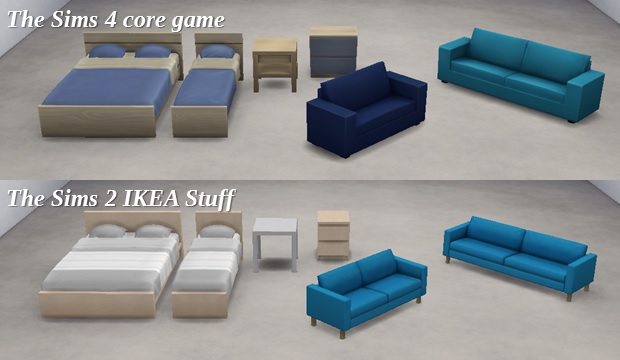
Talking of The Sims, let's shift our attention to The Sims 4 now. I recently discovered why I simultaneously love and hate the cheap furniture from the core game so much, and that's because it's lifted almost verbatim from IKEA.
Back in 2008, Sims Division put out the microcosm-shattering IKEA-branded stuff pack for The Sims 2, which apparently sold better than any of the others. It consisted of virtualisations of Lack, Klippan, and Billy designs, as well as some miscellaneous decorative prints that the retail chain sold at the time (sorry, Blåhaj wasn't developed until 2010). In an uncharacteristic display of intrinsic motivation for an Electronic Arts company, some of the furnishing objects, like the Zes Horizontal Dresser and objects based on it, were merely derived from bits of IKEA furnishings and did not actually originate from there. While I don't think that any of the models they made for The Sims 2 were used to make the furnishings for The Sims 4; as is invariably the case, someone on ModTheSims a while back decided to do an object conversion, porting the objects from The Sims 2 IKEA Stuff to The Sims 4, and allowing me to do a side-by-side comparison...
Suffice to say, the models aren't exactly the same, but there are enough similarities to suggest that the 3D artists didn't have to look very hard for inspiration.