Narration No AI was used in the creation of this track, only my own skills as an announcer and audio producer.
Intro Song: "Retro Bright" by T1na Badgraph1csghost
Other songs originated from their respective games.
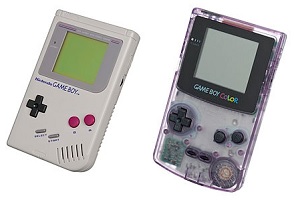
Photo: Evan-Amos, Wikimedia Foundation.
The Game Boy—affectionately called the "Flying Brick" for its portability, durability, and shape—was the reason why Nintendo was able to hold out against smartphones for so long. Credit where credit is due; Nintendo basically invented our modern concept of mobile gaming when they released the Game & Watch series back in 1980. The Game Boy can be seen as an essential step forward in mobile game technology from the calculator-like Game & Watch; a microcomputer powerful enough to make Apple jealous, contained in a little box that could be held in the hands.
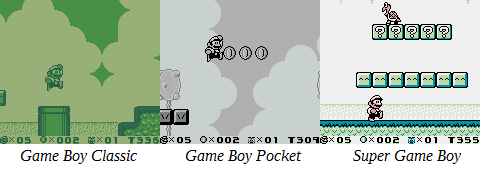
I feel it necessary to mention that the original Game Boy had greyscale graphics. Not monochrome, as some have called it, which would be only black, white, and halftone patterns, but black, white, and 2 shades of grey. These displayed as a sort of dusty olive or army green on the flying brick, and 4 tones of grey on Game Boy Pocket. The Game Boy Color on the other hand used the same graphics technology as the earlier NES, allowing it to display colour. Some Game Boy Classic games, such as Super Mario Land and Donkey Kong, were designed for use with the Super NES's Super Game Boy attachment, and had some limited colour assignments. When played in a Game Boy Color or Advance, these games would use their SGB colour assignments to simulate a colour display. Typically, only Nintendo-developed games used this feature, so the Game Boy Color and Advance had several hard-coded colour palettes from which the player could select by holding down some direction on the D-Pad and either A or B before the game loaded. It wasn't great, but it was what we had back then. The Visual Boy Advance emulator lets you assign your own colours in the same manner through a context menu.
"Eww, greyscale graphics..." Consider the following: Nintendo sold 1 million Game Boys in North America within the first month of release. Ever heard of the NEC TurboExpress? How about the Atari Lynx? Of course you haven't. That's because the Game Boy trounced them by 1991. The only real competitor it ever had was the Sega Game Gear, which only stopped being produced because Sega osborned itself with the Saturn and couldn't afford to make them anymore.
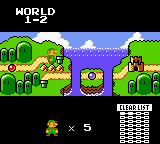
Super Mario Land (GB)
July 1989, Nintendo R&D1 Availability: Nintendo Classics, hShop
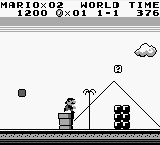
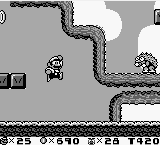
Super Mario Land was more or less commissioned by Mr. Yamauchi to demonstrate the abilities of his company's new game system. As such, it was given to Gunpei Yokoi, the lead designer of the Game Boy, instead of Shigeru Miyamoto, who was working on Super Mario Bros. 3 at the time. As such, this game features almost no elements of either of the extant Mario games (there were only 2 back then). All the enemies, locations, and music were one-offs that were never seen again, though the piece's damsel-in-distress, Princess Daisy, was brought back for Mario sport titles in 2000. It's short, but interesting enough to bring you back after you've finished it.
2
Tetris (GB)
July 1989, Nintendo R&D1 Availability: Nintendo Classics, hShop
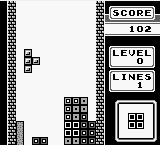
Originally packed in with Game Boy systems from launch to about 1991, Tetris took the already-popular game for 8- and 16-bit home computers and made it portable. As it was between Tetris and Super Mario Land for packing in, it was thought that Tetris would appeal to a wider spectrum of gamers than the more action-oriented Super Mario Land. They ended up being right and it contributed heavily to people's choice to go with the Game Boy instead of the Atari Lynx.
3
Game & Watch Gallery (GB)
May 1997, Tose Availability: hShop
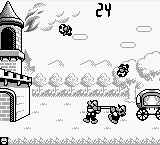
Nintendo's earliest games got Super Mario modernisations with Game & Watch Gallery. Different than the similarly-titled Game Boy Gallery, released in Europe and Oceania only, which had no Mario elements, Game & Watch Gallery was the beginning of a 4-part series featuring modernised Game & Watch games, alongside virtualisations of the ones from the 1980s. The game is a compilation of 4 G&W games—Manhole, Fire, Oil Panic, and Octopus—along with some unlockable stuff, like the Museum which displays information and short gameplay loops of several other G&W games.
4
Game & Watch Gallery 2 (GBC)
November 1998, Tose Availability: hShop
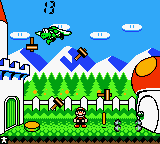
Part 2 in the series featured 5 games—Donkey Kong, Chef, Vermin, Helmet, and Parachute—plus an unlockable 6th one, Ball. Like the previous game, it also features some unlockable Museum pieces and a Sound Test mode, but it's in full colour. It's the perfect game for riding about town in the backseat of the car as your mum and gran go to the charity shops, until they get there and then it's all "No, Tina, you CAN'T stay in the car."
5
Super Mario Land 2: 6 Golden Coins (GB)
November 1992, Nintendo R&D1 Availability: Nintendo Classics, hShop
After the release (and inevitable success) of Super Mario World on the Super NES the previous year, a sequel to Super Mario Land was made whose graphics more closely resembled its 16-bit counterpart. While much of the game is still divorced from the main series, several enemies and items make reappearances here. Though the idea of a Mario Island where Mario serves as monarch never appeared again, the villain of the piece, Wario, was popular enough to get his own series.
6
Donkey Kong (GB)
June 1994, Pax Softnica Availability: Nintendo Classics, hShop
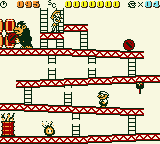
Not to be confused with the similarly-titled Donkey Kong Land—the ill-conceived Game Boy port of Donkey Kong Country—this is the predecessor to Mario vs. Donkey Kong. Sometimes called Donkey Kong '94, the game starts out as a simple modernisation of Nintendo's 1981 arcade game, but that's just the easy stuff. Beat DK on the girders and he grabs poor Pauline and heads into the construction site, and then you're REALLY in for it!
7
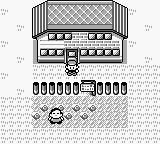
Pokémon Red / Blue (GB)
September 1998, Game Freak Availability: hShop
While Pokémon is not one of those franchises where you need to play every game in order to understand how it all works, you really owe it to yourself to see how the most marketable franchise in the history of capitalism started. This game spawned an anime, a manga, collectible figurines, fast food promotions, breakfast cereal, Kraft Dinner macaroni shapes, and generations of licensed merchandise, and that's even BEFORE it could even display in full colour!
8
Pokémon Crystal (GBC)
July 2001, Game Freak Availability: none
Talking of full-colour Pokémon, Crystal is an enhanced version of Gold / Silver that is compatible only with the Game Boy Color (its predecessor could also load on Game Boy Classic). As you might expect if you've clicked around my other Essentials pages, Crystal is superior to Gold / Silver for 2 reasons. First, most obviously, you have the option of playing as a boy or a girl for the first time in the franchise's history; second, it was ONLY compatible with Game Boy Color, making it somewhat less confusing for newcomers to emulation.
9
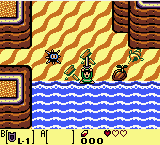
The Legend of Zelda: Link's Awakening DX (GBC)
December 1998, Nintendo R&D2 Availability: Nintendo Classics, hShop
In Nintendo parlance, "DX" or "Deluxe" tends to have the meaning of "enhanced version". In this case, the main enhancement is colour; being a GBC-only version of the Game Boy Classic game by a similar title. The storyline and gameplay are otherwise the same, however; Link washes up on the shore of Koholint with no memory of who he is and is rescued by a girl and her father whose similarity to Malon and Talon from Ocarina of Time is surely co-incidental. It may seem superficial to Zelda enthusiasts, but the full-colour display is the reason why I'm recommending DX instead of mainline Link's Awakening. It's the greatest Game Boy game ever released, and I don't want greyscale graphics to be a deal-breaker.
10
Super Mario Bros. Deluxe (GBC)
May 1999, Nintendo R&D2 Availability: hShop
If you ever wondered why the Super Mario Advance series never contained the original Super Mario Bros., this is why. Super Mario Bros. Deluxe confirms what many people suspected about the Game Boy Color's hardware; that it's just a modified NES, squashed down into a piece of real-estate slightly larger than a TV remote. While this game's selling-point was that it's a port of Super Mario Bros., it also features most of the Famicom Disk System game, Super Mario Bros. 2 (aka. "The Lost Levels"), under the name "Super Mario Bros. for Super Players". It also has a few interesting challenge games to unlock, such as collecting Red Coins and Yoshi Eggs, and racing a Boo. Also, just for yuks, there's a calendar stretching from January of 9 CE to December of 2999... you know, just in case you wanted to mark what day it was that the Vandals sacked Rome. The SMAS version of Super Mario Bros. did eventually end up on GBA, but only for e-Reader and only in Japan.
11
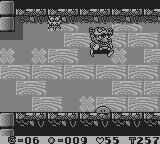
Super Mario Land 3: Wario Land (GB)
February 1994, Nintendo R&D1 Availability: hShop
The sequel to Super Mario Land 2 didn't even have Mario in it! Instead, it handed off the series to Wario, the villain from the previous game. In his first outing, Wario sets out to steal a golden statue of Princess Peach from the Brown Sugar Pirates. An obscure game mechanic introduced here would re-appear 7 years later in Luigi's Mansion; the castle you get at the end of the game depends on how much of the treasure you find during gameplay.
12
Shantae (GBC)
June 2002, WayForward Availability: hShop, Nintendo Switch, Sony PlayStation 4, Sony PlayStation 5
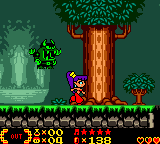
The last game released for the Game Boy Color, Shantae is another of those very rare games to feature a female lead character who is taken seriously. She isn't hidden away inside a power-suit, or based on a popular toy line, or subservient to a male character, or fan-service. The gameplay isn't dumbed down or simplified, either; this is a Metroid-like action game that stars a woman who is realistically feminine and casts spells by dancing. Okay, perhaps a bit of horny game design, but nothing overt or objectionable. Also, the soundtrack was so good, even by chiptune standards, that it was released on vinyl for cryin' out loud.
13
F-1 Race (GB)
February 1991, Nintendo R&D1 Availability: none
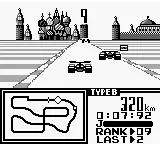
Having almost nothing in common with its Famicom predecessor, F-1 Race was the premier racing game for the classic Game Boy. One of the game's selling-points was its compatibility with the Game Link Cable 4-player adapter, allowing players to race each other over the table at the food court or between seats in the minivan.
14
Castlevania: The Adventure (GB)
December 1989, Konami Availability: hShop, Nintendo Switch, Sony PlayStation 4, Microsoft Xbox One, Microsoft Windows (as Castlevania Anniversary Collection)
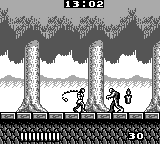
Bringing the MSX and NES series to Game Boy, Konami somewhat simplified the gameplay by eliminating collectable weapons and making hearts restore health. Rather than weapons, like the Dagger and the Holy Water, the player must rely entirely on whip upgrades; however, taking damage causes the whip to reset to normal, somewhat like Contra. It's not very long, given the precedent set by Super Mario Land, but it'll keep you entertained on road trips or during extended stays in the Man Chair outside the fitting rooms.
15
Mario's Picross (GB)
March 1995, Jupiter Availability: Nintendo Classics, hShop
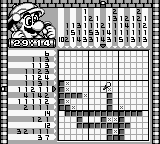
Mario introduces the Japanese puzzle craze, Picross, to western audiences as an archaeologist unearthing pictograms. The puzzle, itself, tells you how to solve it... though it's somewhat less than obliging when it comes to where the spaces are. Think "Minesweeper" but with pictures instead of mines.